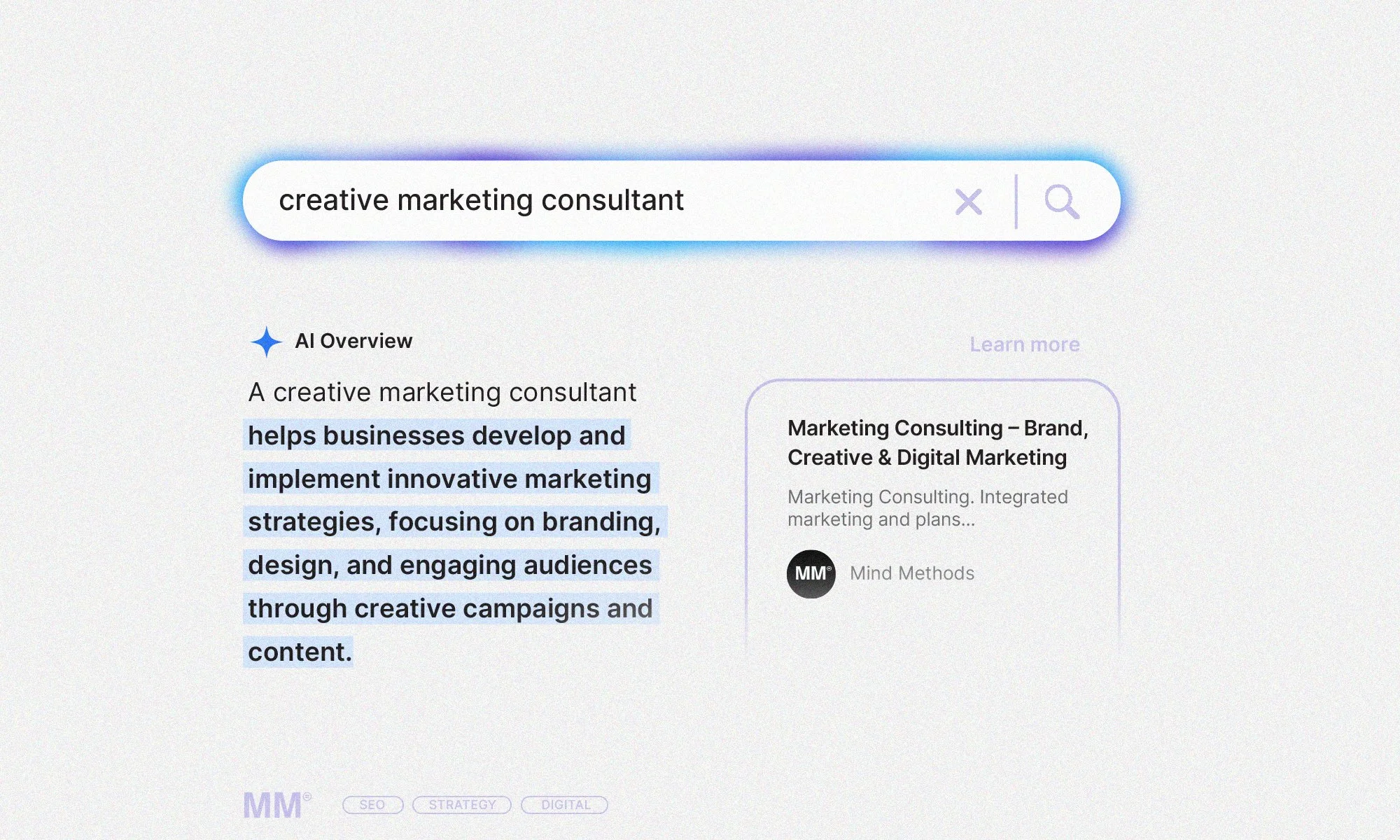
AI can help get an SEO task moving. It can organise research, challenge an outline and turn approved source material into a workable first draft. The important question is what happens next.
Does the page answer a real customer question? Does it say something the business can stand behind? Is it easier to use than what was there before? Those are better tests than the number of words produced or a software-generated content score.
This is a practical guide to using AI within SEO work: where it helps, where to check its recommendations and how to keep the finished content useful to the people you want to reach.
Understanding AI in SEO
AI can help organise large collections of queries, identify themes in supplied data and suggest questions to investigate. It can also assist with tasks such as drafting briefs, reviewing page structures and preparing an initial analysis.
Those suggestions are a starting point, not a substitute for evidence. A tool cannot reliably identify the best keywords for a business without relevant information about its audience, offer, competitors and search demand. Validate recommendations using appropriate research and first-party data.
Machine learning can also support forecasting and pattern detection. Forecasts remain estimates based on assumptions and historical information; they cannot guarantee customer behaviour or future search performance.
Generative AI for content creation
Generative AI can produce outlines, alternative headlines and first drafts quickly. That makes it useful for exploring ideas or adapting original material to different formats.
Speed does not automatically produce quality or consistency. Provide a clear brief, reliable source material and brand guidance, then check whether the draft is accurate, useful and distinctive. The business’s experience, examples and point of view should shape the finished work.
Human review is especially important where a confident-sounding passage contains a factual claim, an invented example or advice outside the writer’s expertise. Someone must remain accountable for what is published.
Balancing AI-generated content with SEO principles
Google’s guidance on helpful, reliable, people-first content discusses experience, expertise, authoritativeness and trustworthiness, commonly called E-E-A-T. These are useful considerations when assessing content quality, not a checklist that guarantees a ranking.
Ask whether the page answers a real audience need, adds original value and makes its sources or authorship clear where relevant. Use terminology naturally rather than inserting keywords at the expense of readability.
Google’s guidance on generative AI content recognises uses such as research and structuring original material. It also warns that generating many pages without adding value for users may violate its scaled content abuse policy. AI assistance is not, by itself, a reason for either a ranking boost or a penalty.
AI content optimisation tools and techniques
Tools can help review topic coverage, group related queries and suggest ways to make an article easier to follow. They may also identify inconsistencies or gaps worth investigating.
Use these recommendations alongside the actual page purpose and customer journey. Adding another section is only useful when it answers a relevant question; increasing a software-generated content score is not an objective in itself.
Performance monitoring also depends on the underlying data source and its update frequency. An AI-generated explanation is not necessarily based on live information. Check the reporting period, source and calculation before acting on a recommendation.
Algorithm updates and AI-assisted content
Search performance can change as ranking systems, competitors and customer demand evolve. AI can help organise a performance review, but it cannot reliably predict the effect of an undisclosed algorithm update on an individual website.
When visibility changes, investigate the evidence: affected pages and queries, technical changes, seasonality, competitor activity and any relevant search-platform announcements. Avoid making large changes solely because a tool offers a plausible explanation.
Keep the focus on helpful content and a technically accessible site. Improving the underlying experience is more defensible than chasing a supposed shortcut after every fluctuation.
Voice, conversational and AI-assisted search
People can express a need as a short keyword, a spoken question or a longer conversation. Clear answers, understandable language and accurate business information help make content useful across these contexts.
Start with genuine customer questions and organise the page so the answer is easy to find. Avoid creating thin pages for every wording variation or assuming that a separate voice-search technique is required for each query.
Google states that established SEO practices remain relevant to its AI features. There is no guaranteed method for appearing in an AI answer. Treat observations from one platform or query as evidence to investigate, not a universal rule.
Using ChatGPT as an SEO assistant
ChatGPT can help explore content ideas, draft a brief or organise supplied research. A productive task might be to compare a draft against an approved outline, identify unanswered questions or suggest clearer wording for a particular audience.
Do not treat generated keyword lists, search volumes or competitor claims as verified research. Check figures against the appropriate source, and inspect any cited page before relying on it. Web search can provide current references when used, but the references and the interpretation still need review.
Use the time saved on drafting to strengthen the work: add first-hand insight, test the accuracy of claims and consider how the content supports the customer’s next step. A regular publishing schedule can help with organisation, but frequency alone is not an SEO strategy.
A workable content-review sequence
Start with a page that matters to the business. Bring together its purpose, the customer questions it should answer, relevant search evidence and approved information about the offer.
Use AI to identify gaps and propose a structure. Have someone who understands the service check that structure before drafting. Then add the business’s own examples, remove unsupported claims and make the next step clear.
After publication, review whether the page attracts relevant visits and supports useful actions. Keep a record of the changes so you can compare the result with the starting point. That gives the team a learning process, rather than another batch of pages to maintain.
Ethics, transparency and quality control
Accuracy, privacy, confidentiality and usage rights belong in the workflow from the start. Use approved tools for the information involved and do not upload sensitive material merely because it would make a prompt more convenient.
Check that content does not invent experience, testimonials, sources or results. Retain a clear review process, especially for topics where incorrect advice could cause harm.
Give readers useful context about how material was created when that context matters, and follow any specific platform or industry requirements. Transparency should help people assess the work rather than serve as a replacement for checking it.
Embrace AI while keeping human judgement
AI can make parts of SEO work more efficient, but it does not remove the need for strategy, original knowledge and careful implementation. The strongest use cases support a clear objective and include a way to verify the result.
Start with a bounded task, compare the full workflow against your existing process and retain what genuinely improves quality or efficiency. Let customer needs and evidence guide the work, rather than the promise of effortless rankings.
About the author
Article by Simon Tokic. Simon’s interests include basketball, music and surfing, although much of his time is spent applying fundamental marketing principles in strategic and creative ways. Before running Sydney marketing agency Mind Methods, Simon worked on brands including Sony Pictures, Universal Pictures, Glad, Chux, Armor All, Clorox, Barbeques Galore and Anglicare.