The fear of talking about yourself
Do you ever hesitate before sharing a project, a recent win or something you have made? It is easy to imagine the person on the other side of the screen thinking that you talk about yourself too much.
For a creative business, showing the work is part of explaining what the business does. The stories we share can also reveal the people behind it: what interests us, what we have learned and how we approach a problem. A newsletter, article or social post can do that in a different way from a static About Us page.
The challenge is to be visible without forgetting that other people are busy. Sharing something you believe in and respecting the audience’s attention do not have to be opposing goals.
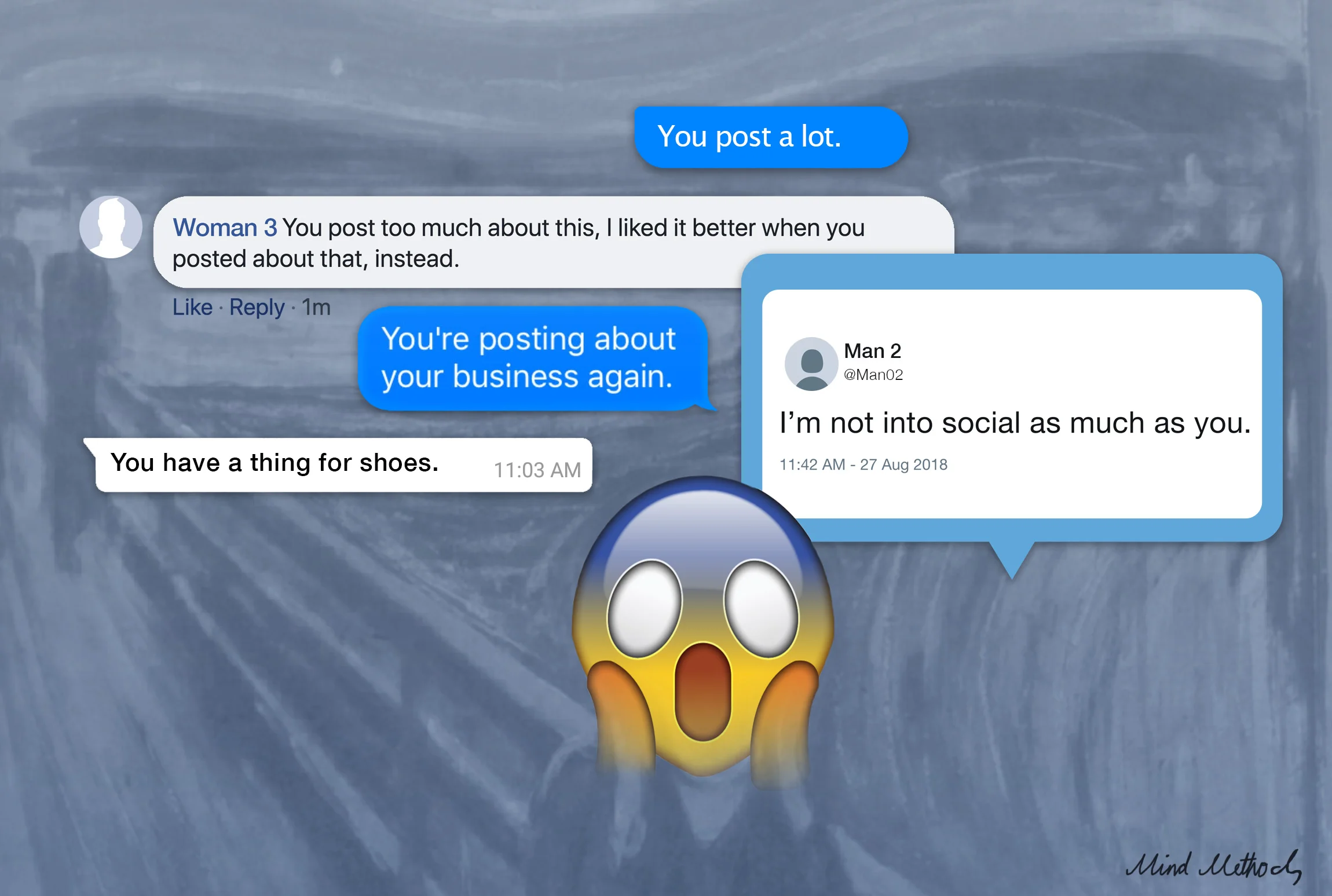
Featured image: feedback shared in the original article.
Different audiences share the same space
Social media can bring friends, colleagues, existing customers and prospective clients into the same audience. A post that is useful to one person may be uninteresting to another. That does not make either response wrong.
Many of us make choices about how we present ourselves online, whether we are promoting a service or simply sharing an interest. At the same time, choosing not to use a particular platform is a legitimate preference, not a statement that needs to be judged.
For a business, the useful question is who the communication is for. Trying to make every update appeal equally to every person can make the message less clear and the work harder to share.
Take feedback seriously without chasing everyone’s approval
You can believe in what you publish and still listen when people say that it misses the mark. Feedback about relevance, frequency, clarity or tone may reveal something worth changing.
It is also worth separating a specific, constructive concern from a passing reaction. Not every person is the intended audience, and not every criticism requires the same response. Avoid assuming that all criticism comes from jealousy or that every negative reaction means the work has failed.
Ask what the reader gains from the post. Is it a useful idea, an honest explanation, a relevant example or a moment of enjoyment? That question often provides a better guide than either complete silence or constant self-promotion.
Visibility is not the same as a relationship
Seeing regular updates can create a sense of familiarity with someone we rarely speak to. We may know about a friend’s recent project without having caught up, or feel familiar with a creator whose work we follow.
That familiarity is not automatically a reciprocal relationship. For a business, being seen is only one part of communication. Listening, responding and following through on the promise matter too.
The tension between performing and making
Eighth Grade and the pressure to perform
Bo Burnham’s film Eighth Grade offers a useful way into this conversation. Its social-media themes raise a familiar question: how much does the feeling of having an audience shape what we choose to share?
Watch the A24 Eighth Grade trailer.
Do What You Can’t
Casey Neistat’s Do What You Can’t video offers a contrasting creative perspective. The possibility of criticism does not have to stop you from making something worth sharing.
For a business, the balance is practical: make something useful, explain why it matters and give the right audience a chance to respond. You do not need universal approval to contribute something worthwhile.
Find the people who understand your work
Work on something because you believe it is worth doing, not only because it receives immediate validation. Be clear about the audience you want to help or interest, and give those people a reason to return.
That does not mean ignoring evidence. It means allowing enough room to develop a useful voice without treating every post as a popularity contest.
Be empathetic
Online feedback is incomplete. Someone may read, remember or discuss a post without visibly reacting to it. A lack of likes alone does not explain what every reader thought.
Share work you are proud of, but consider the reader’s situation. Clear context, an appropriate frequency and a willingness to listen can make the communication more useful. Honesty does not remove the need for care in how a message is delivered.
Do not overthink every response
It is possible to revise a post so many times that nothing gets shared. Set a sensible standard for accuracy, relevance and presentation, seek the necessary review, and then learn from the response.
Give constructive criticism a fair hearing without allowing every passing comment to define the work. A measured response is more useful than either defensiveness or abandoning the message altogether.
Remember the value you provide
Focus on what your audience can learn, understand or enjoy. Show the thinking behind a project, explain a useful process, recognise a collaborator or answer a question that keeps coming up.
Make room for community and conversation rather than treating social media as a one-way announcement board. Listening can help reveal which ideas resonate and which need a different approach.
Self-promotion does not have to mean asking everyone for approval. It can mean making your work visible to the right people, with enough confidence to share it and enough respect to keep listening.
About the author
Article by Lorenzo Encomienda. Lorenzo’s interests include exploring different cultures and discovering new experiences, from travel and subcultures to comedy and professional wrestling.